
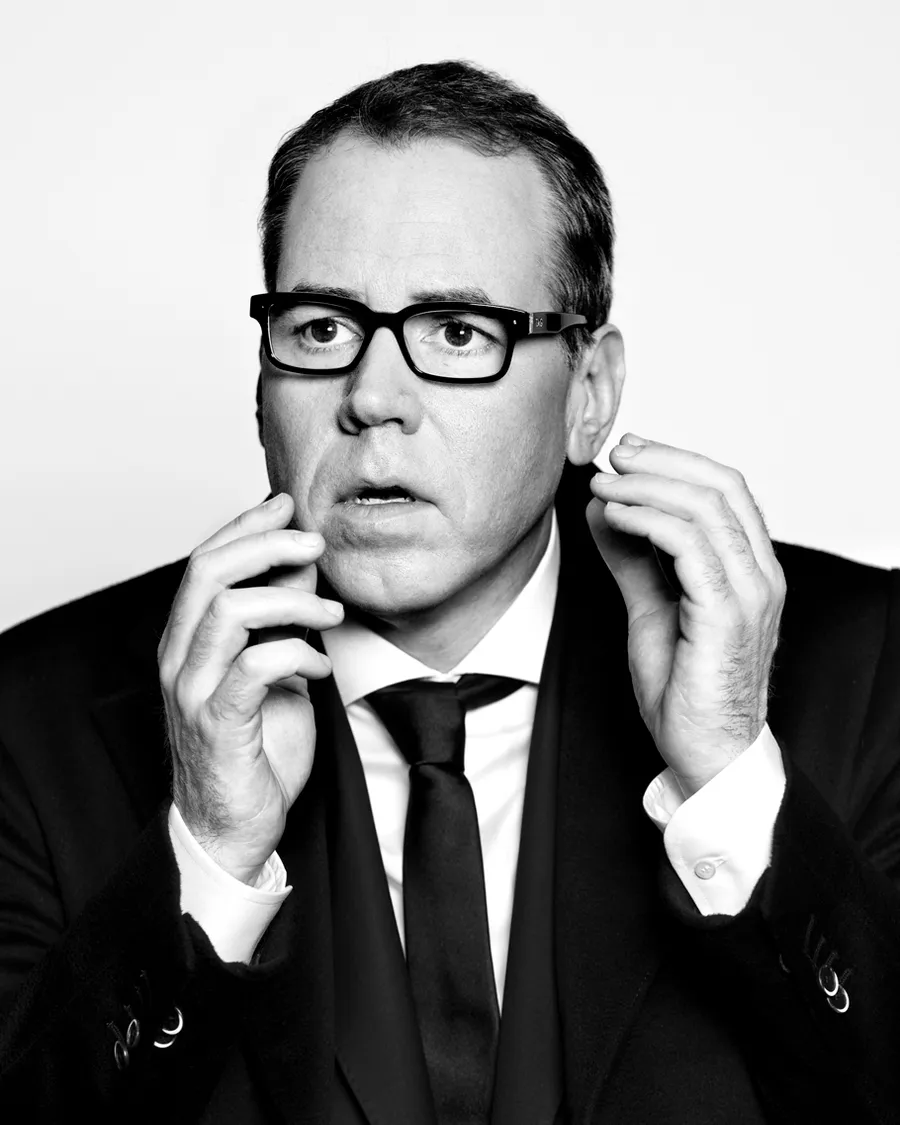
Bret Easton Ellis
“Rock is dead”
Bret Easton Ellis is the writer of Less Than Zero, The Rules of Attraction, American Psycho and Glamorama. Fewer people know that he is also a film critic, a director and an actor. Above all, he is one of those intellectuals who lead us to think about major issues for the first time.
Bret created his own podcast in 2013 and has released more than 60 hour-long episodes. Movies are the central subject of his analysis (see his episode with Kanye West, in which they only talk about movies), yet many of his ideas apply to other art forms, music included.
Bret agreed to a phone interview, and I want to thank him warmly for the time he gave me. He is, in my opinion, the most rock’n’roll writer of all time, and it was a true honor to speak with him. The transcript of our conversation follows.
After it comes an article that analyzes his podcast. Deliberately provocative and passionate, it belongs to our “Lester Bangers” series, a starting point for thoughts not yet explored on Still in Rock: elitism, the distinction between Empire and post-Empire, the usefulness of cynicism, the “culture of singles” and feminism, in short, most of the themes discussed with Bret.
The interview
Transcript of our phone conversation, by Thibault S. Questions in bold.
Hi Bret, thanks for taking the time to make this interview. How are you doing?
Hi Thibault, very good, thank you. How are you doing?
Very good as well, thanks. OK, should we start?
I’m all yours.
Alright. I first wanted to know if you think that rock’n’roll is something serious, and if it should be? Some, as Lester Bangs, said that it is just a joke, not a real serious art form. Do you agree with that?
I think it’s somewhere in the middle. I think that what is important is pleasure. What I liked and responded to about rock music was the certain kind of emotions it gave me. It wasn’t cerebral, it wasn’t intellectual, even if you’re talking about very smart lyricists like Elvis Costello or Bruce Springsteen, it still is an emotion thing that you’re responding to. That is why I do like things that music snobs don’t like. I like trashy and cheesy pop songs. Lyrics don’t really do it for me in rock music.
So, when I say I prefer a kind of dumb rock’n’roll aesthetic, which is what I talked about today on the podcast with Kim Gordon, it doesn’t mean that it is a joke, it simply means that music is emotional. And all art is emotional. This really ties in this notion of pleasure and this notion of craft. We do admire craft, I do admire a great guitarist or a great drummer, but you don’t want in rock to make it look like you’re trying to hard.
But anyway, it’s weird to talk about it because rock is dead. Where are the rock bands? You have to go to country music to find people who are writing pop or rock songs, but that’s all another story.
“Rock is dead”… definitively something that you don’t find in the mouth of many… What about the idea of post-Empire rock’n’roll? In my view, it was created with the punk scene in ’77, this is the idea of underground music. You talked about the Eagles quite a few times in the podcast, and some of your guests responded negatively to it, as Stephen Malkmus. People who like punk music generally dislike the Eagles and this Empire rock movement. Do you personally like both, Empire and post-Empire rock’n’roll, or do you just go to one side or the other?
My taste is expansive, I like all kinds of music, I like country, I like hip-hop, I like soul, I like punk, I like new wave. I’m really not a music snob. I like most music, I really do. It is not one over the other for me. I do understand how punk was a reaction towards a kind of Empire musician in the seventies, against spending years and millions of dollars to get the sound just right, whether you are Pink Floyd, or the Eagles, or Led Zeppelin.
The punk aesthetic was a rebellion to that, a way to say that what’s really great about rock music is that you only need three cords and an attitude. The punks were absolutely against these rich hippies standing in a studio for years, trying to make the perfect record. They were against the fact that music had been co-opted by corporate needs.
But part of the problem with the post-Empire music scene is the democratization of music, the fact that anybody can make music, that you don’t even need to know how to play an instrument or write music in order to have huge hits. That’s a really unusual thing. I don’t know if anything really great has been made from that kind of aesthetic, but it definitively influences so much of the music today. I think it’s really interesting that the sales of electric guitarists have plummeted in the last 5 or 10 years. The idea about wanting to be a rock’n’roll guitarist is really evaporating. Whether it’s good or bad doesn’t matter, it is just happening.
Oh well, it is probably bad, but that’s just my view.
You think it’s bad?
For sure. For instance, Kurt Vile is about the idea of wanting to be a guitar solo player and that is why I love his new record because it is so much about guitar and there are so few albums now about the sound of the instruments…
I like Kurt Vile, too, but I wish he wrote better songs. I know that he’s been playing with a band called The War on Drugs, which is a great American band I think, or at least for the last record. The band really can write songs. I think that Kurt Vile has a great sound and I like the attitude, but I don’t know if he figured out how to write great songs. But then, when I hear myself say this, it sounds so corporate in a way, “Oh, you have to write great songs”. I guess that’s my need, because I like songs, but again, I can also listen to Kurt Vile’s jams for 8 minutes, so…
Yes, I guess what is important at the end is the all experience, made of great songwriting and jams and guitar solos… That leads me to ask you about what Ariel Pink said in your podcast, that maybe we should forget about the best bands of the last fifty years, so young artists can create something really new. It was the first time that I ever heard about this idea. Do you agree with that? I think that the same goes for writers actually, the idea that young writers should not read any of the best authors so they can create something personal.
Well, I think that it is probably happening. I personally don’t think that it is a good idea. I don’t know why anyone would not want to listen to old music, or read old books, or watch old films.
I am certain that the millennial generation and the generation Z, which is about to emerge, is confronted to the problem that there is too much information. I remember when I was complaining to a younger person, “Why have you not seen that movie?” or “You haven’t heard that Rolling Stones record?” or “What do you mean you haven’t read Raymond Carver?” The answer was, “I wasn’t born then, sorry.” Well, I wasn’t born either when the first Bob Dylan record came out, but I’m interested in it. I wasn’t born when a lot of my favorite books came out, but I’m interested in them. At first, I was quite pissed, and I thought that it was a ridiculous answer.
But then, I realized that it was kind of a cry for help. I was kind of saying, “I’m drowning in information, I barely have time to get to the new information coming my way.” So then, how can you go to the past? How can you expect people to spend time going to 1975? At the end, I am really sympathetic to that. You really have to try harder than ever to make that kind of commitment to look in the past.
I think that everything arose from something else. I don’t think that it can just be a line drawn, and that you can not listen to anything and make new art. I think that everything influences everything, for thousands of years. So, I get what Ariel was saying, but I don’t know if it’s a realistic thing.
I personally agree with that idea that there is too much information, I feel that all the time. I am then wondering if you believe in the notion of objectivity in art, as Oscar Wilde did, which basically lead to the idea that young artists are able to evaluate what they are creating without comparison with another decade, or another artist, in sum, without this massive amount of information. Every time I talk about this notion of objectivity, the answer is, “Oh, of course there is no objectivity in art, nothing is objectively beautiful or objectively bad”. I disagree with that, because for me there are some universal things in the best pieces which makes them great or not. What is your take on that?
It is all subjective, of course. There is no objectively great art, and thank God. I love when people have contrarian opinions about something that is supposedly great and good for you, that you have to read or watch. It is really healthy, and I love the idea that there is no objectively good art. Now, I think that millennials want to believe in that, that everything is good or that everything is bad if it doesn’t correspond to a set of values. This is a big problem in the society nowadays, in this kind of aspirational “like everything society” where just because a work of art is about something or has a kind of progressive feel to it, there is automatically a kind of positive embrace of it, no matter how shitty it is. It seems to be a certain acceptance of it, despite its aesthetic. That bothers me, but to put it simply, I think that everything is subjective, and I’m glad about that.
Now, I say that as a writer. I’m having a writer on the podcast tomorrow and you’ll talk about this notion. We’ve been writing for many years, and yes, we can take a book and say, “This is really bad writing, I’m closing the book now”. And so, in a way, I don’t know if I’m contradicting myself, but I feel like I can pretty much tell if a book is good or not, objectively. I can say, “This is not good writing, this is blowing, why are we on page 4 and this still is not interesting?” I say that, and yet, my reading of the book is subjective, even though objectively I know it might not be good.
We just talked about this “society of like,” where everybody wants to be liked, where Facebook likes are all over the place. You expressed the idea that someone who expresses his opinion is often considered as being an elitist. I do agree with that, but I was wondering if you think that it also applies for someone expressing a positive opinion? Or maybe it is just the fact to have an opinion which is forbidden in a way…?
Here is the problem. We are in a corporate society. We live under corporations, whether you like it or not, and we live in a society where we advertise ourselves on social media, all the time, whether it’s Instagram, Twitter, Tumblr, Facebook, whatever. We are putting ourselves out there, we are selling a version of ourselves. Everyone in the world is doing this. In corporate culture, you tend to stay positive, because you are selling things. You need to be positive, you need to be happy, you need to like everything. Who’s going to buy something from some angry grumpy troll who thinks that everything is a piece of shit and that society is a lie? OK, well, I might…
Now, overall, people now don’t like negativity because it contradicts what they are trying to do. That’s why, if you say something negative or have a contrarian opinion, God forbid, you are immediately attacked by the mob, because it is going against the the grain of what everyone is doing. That is very disturbing, this idea that we all must march in step with the corporate culture, follow the corporate rules, because we are selling ourselves. Pressing the “like button” is what you do in corporate culture, you don’t press the “not like button”. I think that people are attacking those who have minority opinions, when in fact they are just opinions. You can paint an opinion black or you can paint an opinion pink. It is just an opinion! That is what is happening, it is a fact that we live in a corporate society, and if you have a negative view on something, people will attack you.
But then, what about comedians like Louis C.K.? He expresses negative opinions all the time and yet, people love him.
Hmm, I don’t think that Louis C.K. has negative opinions. I feel that he is someone who has actually found a middle ground. When I watch his shows, it is one thing, and stand-up is another. His stand-ups are not angry comedies and it is not very cutting edge. Even on the show, as a family man, as a father, there still is a kind of sentimental quality to Louis C.K. Even when he did his bit on Saturday Night Live about the pedophile, that was the harshest thing I ever saw Louis C.K. do, and yet, it is still caught in a positive questioning Louis C.K.’s style of telling a joke, which I thought made it even more shocking in a way.
I find very few people right now who are in the art and who aren’t changing their values and moving into corporate culture. I think that we are in a transitional moment where maybe people will figure out how to be themselves, be their contradictory-selves, a man made out of contradictions.
You think this is happening, that people and artists moved away from their core values?
I think this is already happening, indeed. It really began when social media came into play, especially Facebook. It was the beginning of putting your best-self out there. This is happening when criticism began to seem elitist, because it didn’t correspond with the way people are presenting themselves.
Well in fact, I feel like as a millennial myself, I can really see that. OK, now, I would like to talk about what Gerard Way said in your podcast. He explained that he is looking for some theatricalness in his performances. It is, for me, exactly what David Bowie was doing as well. I’m wondering if it is a good thing, because these artists are basically creating a fake identity to go on stage with. As you said in your conversation with Judd Nelson, sincerity is the most important thing for artists. There is for me a clear contradiction between the two, you either create a fake identity or you choose to be sincere…
It depends on what you like and how long you can sustain it. Yes, Gerard Way created a character for My Chemical Romance. And to a degree, he is doing it as well for his solo career, even though his is more of a transparent Gerard Way. I think of Nicki Minaj, too. I remember when she had characters she channeled. Now, she doesn’t, she is just Nicki Minaj, and I wonder if it is something you grow out of as you get older. And it also depends on the persona I guess. Sometimes, the persona is a very honest indication of who you really are. Sometimes that really gets the message across in a way, and to a degree, it depends on how much you want to play with it.
I think that people do demand certain kinds of reality. Or at least, whether it’s reality or not, they demand a certain kind of authenticity. I don’t know how well that plays for all the bands that I like now. I watched the MTV Video Music Awards and pretty much everyone is real, Miley is really Miley Cyrus, she’s not an act, Taylor Swift is certainly herself and Kanye is himself as well.
I think that we moved into a time in which people do create a certain kind of authenticity. It doesn’t mean that you erased theatricality, I think for instance that rock shows are more theatrical than ever, they have to be in order to get people in. The idea of having just a band playing on stage without visuals everywhere simply doesn’t happen anymore. That doesn’t happen at Coachella, that doesn’t happen at any music festival in fact. Everything’s got to be a show. But I do think we do expect certain authenticity from the frontman, the singers, the performers, whether you are The Weeknd, whether you are Sia. I’m trying to think of a huge pop performer right now who is kind of hiding himself in an act…Justin Bieber certainly isn’t.
People are also looking for a certain kind of sentimentality, a victim narrative. You certainly see that in young musicians like Sam Smith and Ed Sheeran. It does seem to be a lack of anger and a lack of lust, which are authentic things that seem to be missing with the new generation of musicians.
Oh probably! Maybe this lack of anger comes from the fact that real anger doesn’t sell much. Maybe it comes from the fact that we want an idyllic representation of our artists. Everything has to be perfect, fast and perfect. Speaking of which, as you mentioned several times in your podcast, artists are using the “single” format more and more. The all album now is kind of a heroic performance. It does seem that very few people care about the entire album anymore, it is all about the singles, watching them on YouTube or listening to stuff on Soundcloud, without context.
There is for me a clear link with what Hermann Hesse was describing as the “society of speed”, the idea that we have so much information coming our way and that we must always expose ourselves more, we must accelerate the speed to which we destroy our private life. The impact on art is huge. What are you doing, as an artist, to fight against this, not to publish a book every year, not to make a new movie every year? Do you feel this pressure, do you feel like people are asking more from you?
Of course I feel that way! I feel that way everyday! I feel like I have to put pictures on Instagram all day long. I feel like I need to tweet all the time. I feel like I have to constantly update my Facebook profile. I don’t. But I feel the pressure. The pressure is everywhere to do this, to put yourself out there, to make your voice heard all the time. I’m tired. I don’t operate that way, and I can’t force myself to operate that way. I feel the pressure from social media all the time to publish another book. But writing a book takes a very very long time, so that is just not a possibility.
I’m actually doing many things in my business life. For example, this week, I am getting my podcast ready, I am updating a screenplay I wrote, I am writing a piece of journalism, I am writing a web series for a new web channel and I’m also working with an artist here in L.A. on an art installation that we are going to premiere in February.
I feel like because I have so many things available to cross over with, so many ways to connect with artists, musicians and film-makers, I am much happier than just being the novelist in New York. Before technology connected all of us, I was kind of in my apartment, writing a novel. I think this is a much more exciting time. It is sad for people who want a new novel from me, but I can’t force it, I can’t fix a new novel. And I also don’t even know where the novel is going anyway. I have my doubts about the novel in general.
So yes, I constantly feel the pressure to express myself, to be out there. I don’t know how everybody doesn’t feel that, and I admire people who simply walk away from it all. I admire people that just aren’t on Facebook, aren’t on Twitter, aren’t Instagraming all the time. I am in the middle. I like that I have it, even though I might not be using it correctly.
Well, I think we’re done, it must be time to go back to our Facebook profiles! Many thanks Bret, I really appreciate the time you gave me.
My pleasure, Thibault. Alright, let’s speak soon. (…) See you.
Analysis of the podcast
By Thibault S.
I. The change in the music industry
Music and “elitism”
During his conversation with John Densmore, the drummer of the Doors, Bret formulates for the first time one of his favorite statements: someone who expresses an opinion is often taken for an elitist. I fully agree. The idea follows from a change in the music industry and from what came with it, the emergence of the “society of like” and the leveling of criticism that led to it.
This brings us to the importance of criticism. Bret theorizes his “Generation Wuss” in his dialogue with Ezra Koenig, the leader of Vampire Weekend. He describes millennial artists who no longer accept the possibility of a negative review. Ian Svenonius criticizes the same generation in his song “Reparations” (“People talk about reparations, yeah, they do”). Bret contrasts it with Generation X, born in the seventies, cooler, more detached, and never inclined to challenge the importance of criticism.
Ezra Koenig disagrees and defends the idea that every generation has trouble accepting criticism. Both agree on another point: it is easier to criticize a work from behind a screen than face to face. Kurt Vile says much the same when he denounces the readers of Brooklyn Vegan, these “pseudo hipster dudes” he finds particularly harsh. Bret suggests that the Internet shines a light on opinions that existed before and were simply less visible.
And I cannot help but ask: so what? Why would picking up a pen be less legitimate than raising one’s voice? Isn’t the sincerity of the criticism the central point? The trouble with criticism on the Internet is that it gives the artist no opportunity to answer, yet curiously this never discredits the good reviews. The anonymity that writers enjoy online frees them more than it pushes them to outrage.
Back to elitism. It spreads through a culture ever more focused on “niches”, where everyone claims to be the specialist of a sub-segment. This niche culture is the product of the society of over-information, the “endless dream of content” that Bret describes in his interview with Marilyn Manson. Some people get lost and give up (radio listeners, for instance). Others take the opportunity to explore the entire matrix of rock culture. Can one legitimately say that there is something fundamentally wrong with the development of niches? Do we mourn the giant rock stars who filled stadiums, as Led Zeppelin did? Let’s not forget that filling stadiums was never the vocation of rock’n’roll.
Bret puts his finger on another essential feature of such a society in his interview with Bruce Wagner. The continuous flood of information tends to produce young artists who struggle to pay attention to what existed before they were born.
Recall his conversation with Ariel Pink, one of the best of them all. Maybe the sixties are not made to last. Maybe we should, and will, forget the Beatles, the Stones and the Kinks. Maybe young artists should be left to make bad music, without father figures hovering in the background, so that they can stand on their own two feet and live or die by the mediocrity or the genius of their creations. Here the digital society of over-information has the advantage of hiding the geniuses of the past. Note, however, that such reasoning supposes the idea of “objectivity” in art, the idea that young artists can judge the mediocrity of their compositions without taking stock of musical history to find a basis for comparison. I personally believe in such an objectivity, the one Oscar Wilde described so well, but I cannot help thinking that the story does not end there.
Can we accept that the true geniuses of the past be forgotten if it means more of today’s mainstream? Do we wish to live in a society where the word “Beatles” is a misspelling of “beetle”? Can we stand a musical scene that no longer knows what the blues is? These examples may be a little extreme, but they show the limits of Ariel Pink’s reasoning. This is why Still in Rock does what it does, so that we can (pretentiously) find what must be found. Great journalism must keep warding off the overflow of content. Tomorrow’s artists need the legends, objectivity in art or not. The best of them will surpass their founding fathers or innovate on their work, and the bad ones, at the very least, will still be able to copy them.
Empire and post-Empire
The conversation with Marilyn Manson is interesting in several respects. Mostly devoted to the film industry, it also holds relevant thoughts on racism, on rap music and on what it takes to stand against the system. Manson says he is now stuck in the pop culture he criticized in his early days. He is, in other words, stuck in the Empire.
Empire culture is the culture of blockbusters and stadiums. Bret devotes a large part of his analysis to the distinction between Empire and post-Empire when he meets Gerard Way, who wants to bring as much theatricality as possible into his music. David Bowie did the same, and Bret is not opposed to it. But why, and how, would it be acceptable for an artist to build a false mystery around himself by inventing a character, a fake identity? Lester Bangs already denounced the “empty” artists of the Blank Generation, whom managers could “fill” as they pleased. An artist who admits to seeking theatricality confesses that he is hiding his true identity. Can a prefabricated identity be interesting at all? The answer is very simple: no. To argue otherwise is to give a rationale to the Empire culture, where the enormous and the stunning must triumph at all costs.
The Empire and post-Empire debate returns in his discussion with John Densmore, where the marketability of music is the central subject. Densmore explains that Jim Morrison objected to the use of the Doors’ songs in commercials, while the rest of the band was less certain. Bret seems to side against Morrison and draws an analogy with his own podcast, which could not exist without the support of advertisers. In my opinion, Bret wrongly likens a podcast to a rock’n’roll band. A podcast may need support to carry serious topics and reach its audience, and it can fit into the system. A band should not need such support: rock’n’roll that takes itself seriously enough to seek commercial backing is dead rock’n’roll. Bret’s position surprised me here, since he usually argues that rock’n’roll should not be a serious art form. All told, his opinions on Empire and post-Empire are complex and many-sided. He rejects the Empire when he calls for more anti-system music, and that is him being punk and straightforward, yet he accepts the marketability of music, which is, in my view, inconsistent.
Cynicism in art
One of Bret’s best podcasts is the one with Stephen Malkmus, the former leader of Pavement. The episode shows that Bret had the good sense to invite one of the greatest musicians and performers there is. Bret expresses his admiration for the band, as Craig Finn does in a later episode, and points out how Pavement changed his idea of what being in a “band” means, turning it into a kind of post-collegial DIY movement.
In this conversation, Bret declares his esteem for several classic rock bands, Led Zeppelin and the Eagles among them, a view I do not share (see our article on Lester Bangs). Yet Bret denounces American Idol and its sister shows (The Voice and other similar shit), which seek technical triumph at the expense of the soul. The two positions seem contradictory. They make sense a little later, when Bret describes Pavement as the first band to bring a new sensibility into music: lo-fi, cool, cynical.
Pavement was the first band without an image, unlike the Replacements. In a sense, Bret describes Pavement as the symbol of Generation X, a band that did not take itself too seriously and avoided sensationalism. When Pavement had a hit (“Cut Your Hair”), it came out of pure cynicism. “You wanted a hit? There it is, but please know that it doesn’t represent us.” No band embodies this sentiment against popular culture better than Pavement, the sentiment that made it stay with Matador and turn down the majors. Bret approves. Both agree that the eighties were a bad decade because, in short, most artists were shaped by their managers. This is the Blank Generation!
Bret says similar things to Craig Finn when he details his love of “dumbness” in rock’n’roll. He complains that there are no more anti-system bands. Many times during the second season of the podcast, he notes that the entertainment industry has stopped supporting small projects. He even wonders whether making movies and producing albums should finally become a hobby, to rid ourselves of the Empire. It already is one for the small independent labels that do a great job, Howlin Banana Records for example.
In a long tirade, Stephen Malkmus denounces the interviews in which journalists describe Pavement as “a product”. He ends up challenging Bret about his own relationship with fame. Bret replies that he always prefers to smile and answer journalists politely, aware of being part of “show business”. The answer confirms how complex his relationship with showbiz is: it never stops shifting.
II. Rock’n’roll as a mirror
The culture of “singles” and the “society of now”
One of the most recurrent subjects of Bret’s podcast is the distinction between singles and full-length albums. In his interview with Marilyn Manson, Bret points out that we live in a society where culture is fragmented. YouTube has become one of the major media outlets, primarily because the content it hosts is (very) short. And the “culture of singles” keeps growing. Having to learn an instrument is now seen as an obstacle, because it delays fame.
Bret tackles the issue with Kurt Vile. He laments that singles have become the main way for musicians to speak. The intensity of a good LP grows over time, while a single is limited, a mere piece of a bigger jigsaw puzzle. With Ariel Pink, he adds that it is probably a major mistake to focus on singles at the expense of the whole album.
This “society of singles” also comes from the all-digital world in which we (almost) live. Social networks spread music very fast. Bret then introduces a distinction between the analog world and the digital one, mostly in terms of mystique. The first, slower than the second, tends to preserve the mystique of artists. John Densmore defends the same idea, and Hermann Hesse theorized it more than fifty years ago when he blamed the “society of speed”.
After all, isn’t art only a matter of context? James Gray thinks so. As he said on the podcast, the appreciation of a work depends on many things, where we experience it and what the medium is. Is the experience as powerful when I click on “play” as when I put a record on my turntable? Certainly not!
Yet, as Nic Hessler told us in our interview, who has never enjoyed listening to an mp3? And how could we complain about a culture of abundance in which it is more or less possible to listen to any band on earth? At the same time, how many people really use the possibilities of the open Internet, and how many simply follow the culture of radio? The fact is that while the digital world gives easy access to music, the importance of shows is growing as a kind of protest (just look at the number and the size of summer festivals). The reason is simple: music is analog.
Watching a clip on YouTube will never replace going to a show. At this point, I do not believe that the digitization of music can go much further. What remains of analog reality belongs to the venues: the smell of a crowd, the feeling of a room plunged into darkness and, also, the joy of using an object, a vinyl record or a cassette, to listen to music. Only analog reality makes the process unique and personal. It takes the listener out of the repeatable experience of a video clip on YouTube.
Rock’n’roll as a reflection of social issues
In the words of Lester Bangs, rock’n’roll is a reflection of society, not one of its engines. But what a reflection! Feminism is probably the most obvious example.
In his interview with Ariel Pink, Bret discusses feminism in the music world and elsewhere. He argues for moving into a post-feminist society, just as he often calls for a post-gay society, where homosexuality is no longer the central subject but one element among many. This post-feminist society, he says, is the sine qua non condition for the objectives of feminism to be met. It is therefore wrong to say that we cannot enter a post-feminist society because those objectives have not yet been met. The discussion raises the question of sexuality in music. The Riot grrrl movement, born in Washington, D.C. in the early nineties, was the feminist punk answer to the much more testosterone-driven scene of Fugazi and company. It was salutary. But is it still necessary? Should the issue of sexuality be transcended in music? Few fashion models turn into underground rock stars, proof that the independent scene has pulled itself out of the clichés of the “women’s magazine” society, right?
The discussion continues in his interview with Peaches. Bret completes his theory: women such as Miley Cyrus use sex to sell their songs, and men do not, or very rarely. Peaches replies that both use it, in different ways. According to her, women embody sex while men speak about it. In my view, men and women both speak about sex, while far more women embody it. Men also use sexual images of women: see 80% of the videos on YouTube. So there is an issue of sexual identity, but mostly in mainstream music, far from our independent scenes, which seem to suffer less from it. The use of women’s image is undeniably a much wider problem with the majors than with independent artists. So when I hear that independent music no longer exists, I cannot help pointing to this fundamental difference with the world of television.
The debate on gender identity goes on in his conversation with Rose McGowan. Bret explains that movies show women the way others think of them, and that this picture ends up determining their future. Men are shown differently, taught that they are masters of their own destiny. If the statement holds, it is, in my view, what separates the very best female rock stars, such as Kim Gordon of Sonic Youth, from the (very) large majority of the others. These “others” include Madonna who, as Ariel Pink said, “has never been free”, because she could not create a real connection with her audience, because she is too professional and too ambitious and, in short, too fake.
A few closing words
Our admiration for Bret’s podcast is not shared by everyone, though others have fallen in love with it too. I have noted several points of disagreement with his views, and still I cannot help thinking that it is one of the clearest and cleverest conversations about art there is. Anyone with an interest in music, cinema, literature, painting or any other art form should try it, because it makes you think about subjects that deserve to be thought about, sometimes for the first time.