

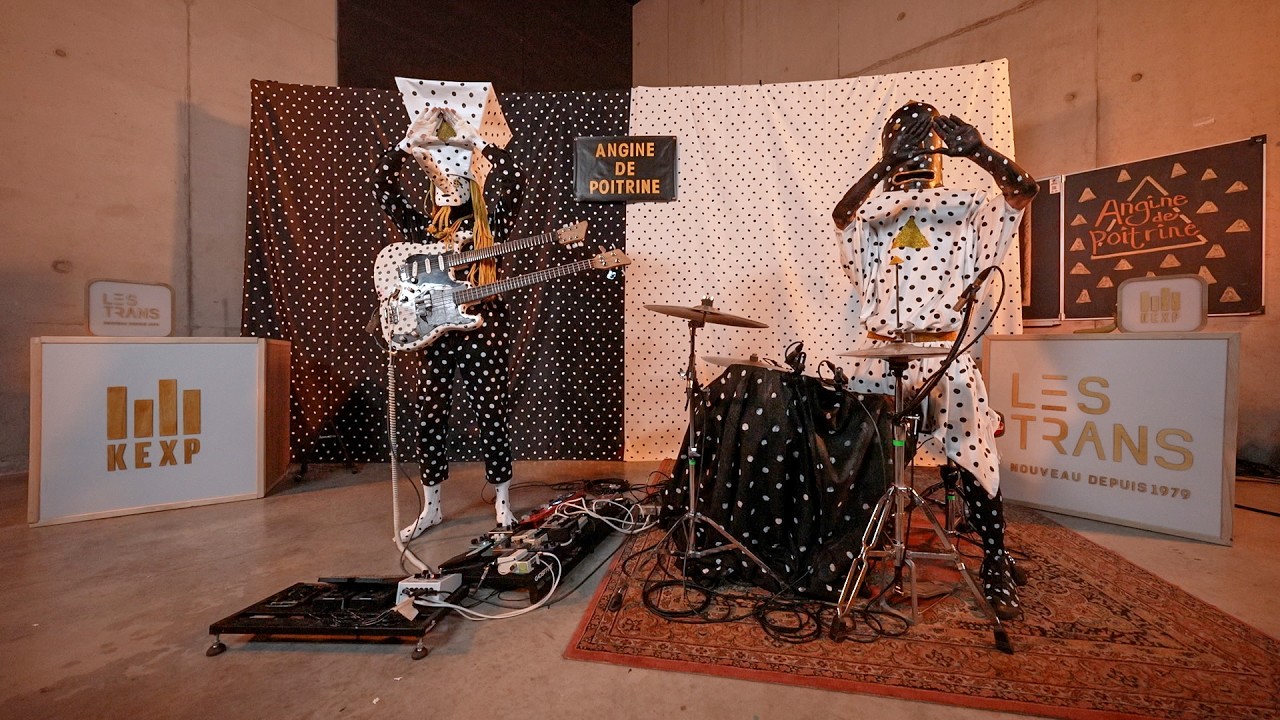
Some records are good, some are great, and then once in a while something rolls in out of nowhere, no warning, no label that sticks, and you feel it right away, something shifting, something opening, and you’re already somewhere else.
You try to name it at first, of course you do.
But it doesn’t really help.
What you hear instead is movement.
Guitars that hit like Shellac for a second, then drift somewhere closer to Polvo, then open up, stretch out, something psychedelic not far from King Gizzard, and then suddenly warmer, wider, like air at night, like you’ve been dropped somewhere in the Sahara, late, no one around, maybe Tinariwen somewhere in the distance.
And then even that disappears.
Angine de Poitrine does not settle anywhere despite such a strong rhythmic section.
Vol. II doesn’t feel “original.” It feels new.
Not new as in different. New as in: we don’t really have the coordinates yet.
There’s psych in it, math rock in it, hard rock in it, yes, but it moves through all of that, it doesn’t stay still long enough to belong anywhere. It grooves, constantly, everything is in motion, and before you realize it you’re already inside it.
And around it, there’s a whole world.
Costumes, masks, some kind of internal logic that makes sense only once you’re in.
They speak the language of whales, or something close, or something that feels like it could be.
At some point you stop asking and just take it.
Then you start listening differently.
Quarter tones first.
Notes that don’t land where they should, slightly off, slightly wrong, but not wrong, not really, just somewhere else.
It brings to mind Prokofiev’s War Sonatas, that same way of making something complex feel immediate, almost obvious.
Dissonance that draws you in instead of pushing you away.
Then the ghost notes.
Notes that aren’t played.
You hear them anyway.
You hear the space where they should be and your brain completes it, fills the gap, and suddenly you’re listening to absence as much as presence.
It’s controlled. It’s extremely precise. It’s addictive.
You start waiting for what won’t come.
And then the pedals.
Khn de Poitrine is there, working them with his feet, slowly, almost invisibly.
Not switching sounds, not jumping from one to another, but sliding, easing into them.
He turns the volume of the effects little by little, and the texture stretches, they evolves on a spectrum.
Nothing breaks. Nothing cuts.
It just keeps becoming something else.
Until, suddenly, it doesn’t, and everything collapses at once.
And finally, the loops.
Some of them you don’t even hear when they’re recorded.
They’re played, but hidden, kept somewhere under the surface.
He records them without giving them to you, holds onto them, brings them back later when you’re no longer expecting them.
Which means he has to carry them the whole time, hear them before you do.
The music exists ahead of itself.
That’s not normal.
Yet none of this feels like a demonstration.
No showing off, no “look what we can do.”
It just moves. Again.
That’s why Vol. II feels rare.
Not just good, not just strong, but one of those records that quietly rearranges things a little, shifts the way you listen without announcing it. And make you smile. Again.
After nearly 4,000 articles on Still in Rock, you start to recognize these moments.
They don’t happen often.
This is one of them.
You may also like
Album Review : Delta Spirit – I Think I’ve Found It (Folk Rock)
Delta Spirit. Une formation qui, depuis plusieurs années, me séduit par une folk très rock, une f
Anachronique : Beat Happening (Indie Rock)
Je me souviens de la première fois que j’ai rencontré Calvin Johnson. C’était le
Interview Still in Rock : Wyatt Blair (Power Pop)
As we noticed for the year-end ranking of 2013, the Album Review of Banana Cream Dream was the most