
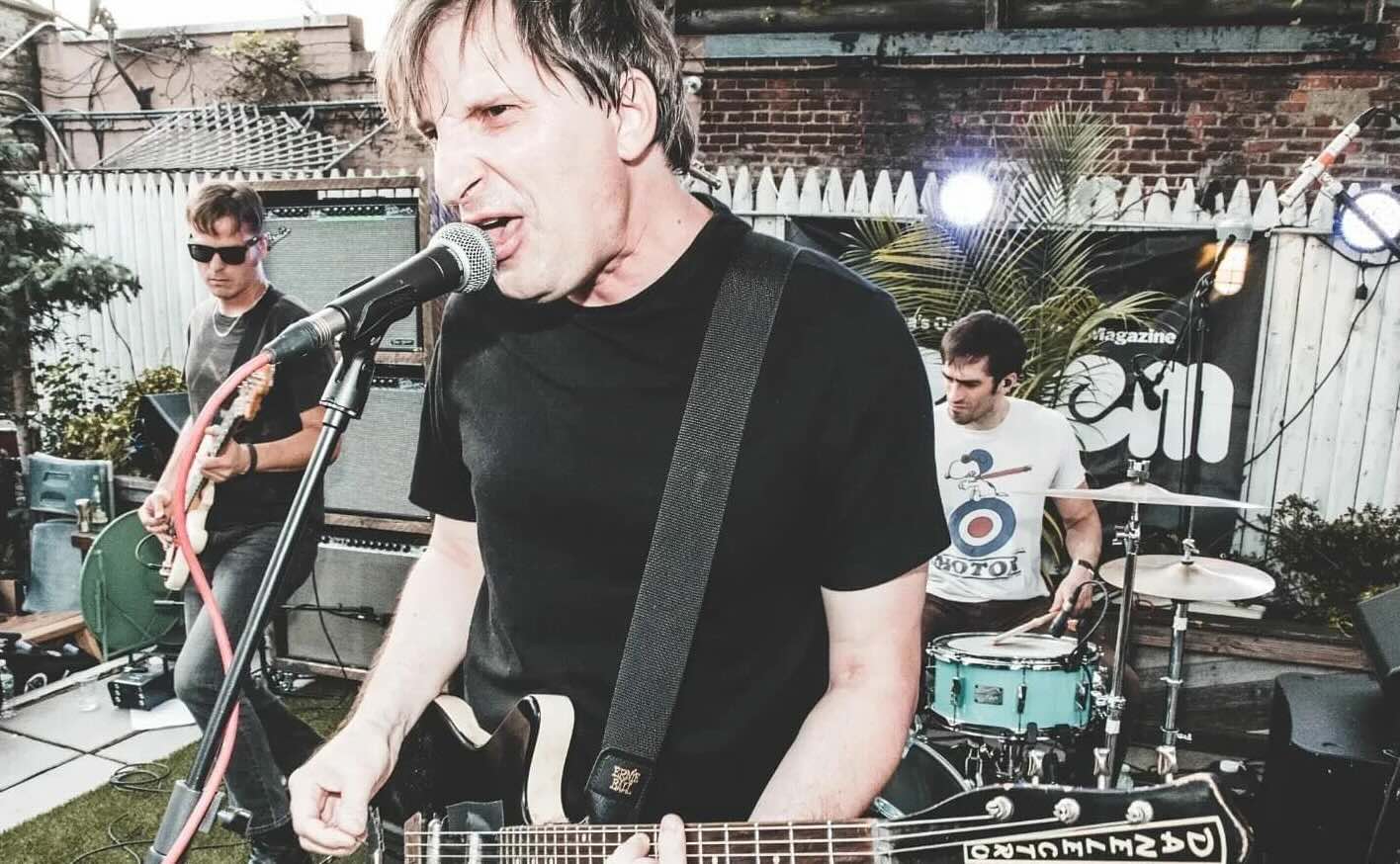
I have done nearly 80 interviews for Still in Rock. But only two since 2022. So going back to it meant one thing: the conversation had to be with a band that feels like a legend in the making. Here is Radioactivity.
**
BACK STORIES
How did it all start? You have played in so many projects over the years, but Radioactivity feels like the point where everything crystallized into its purest form.
Radioactivity started in 2012 when I returned to Texas after living in Japan for a few years. I had a band in Japan called The Novice that played some of the same songs and Radioactivity took over once I was back in the states. At first I had planned on continuing it as a solo recording project, but after a couple attempts at recording the first album myself, I decided I’d rather get a band together and do it properly. Mark (bass), Daniel (guitar) and Gregory (drums) joined the band and we started recording and touring pretty quickly thereafter.
First things first: I am obsessed with “Erased.” It has that perfect mix of tension and melody that defines Radioactivity for me. Tell me the back story behind this song.
I don’t always have the best memory when it comes to songwriting, but if I remember correctly, Erased was the first song I wrote after we finished recording the Silent Kill LP. I had recently written the song Pretty Girl (the last track on Silent Kill) and at the time I liked the idea of having a simple guitar line repeating throughout the entire song with the chords changing around it (like was common with the Dutch band Ivy Green). Pretty Girl and Erased were both written around a guitar line like that. Lyrically, it was loosely about moving forward after a relationship.
Going further back, The Potential Johns is such a great band (with “Past Due,” so good), yet strangely hard to find today. What’s the story behind the band? How did it start, how did it live, how did it end?
Potential Johns was a band that started in 1995 with a couple of my friends. When it started I split the singing and songwriting duties with my friend Patrick, who was a founding member of the band, Riverboat Gamblers. We lived in a house that had frequent house shows and we basically played there all of the time. We never toured or anything with that original line up. The band kind of fizzled out eventually, but I used the name for a solo recording project I had. I recorded to cassette, mostly just to demo the songs. Some of them were re-recorded and released and many weren’t. The song Past Due was written and recorded years later, but since it was a solo recording, I continued to use the name Potential Johns.
One thing that always strikes me across your projects is the sense of urgency. The rhythms are fast, the lyrics almost feel chased forward, the guitars cut sharply. And beneath that urgency, I hear a recurring theme: the difficulty to exist, to be seen, to make it through an overwhelming world. If my analysis is correct, how do you explain that theme being so present in your songwriting?
I’ve always thought of songwriting as therapeutic. I think it can be a way for me to work out stress or difficult issues I may be dealing with at the time. I think it’s kind of like a journal in that way. Usually after writing and demoing a song, I feel better and get back to life as usual.
EVOLUTION
Your sound is what I would describe as “post-2001.” I know it’s not fashionable or underground to mention The Strokes anymore, but I hear a broader scene that shares this crisp, high-energy guitar sound, including bands like Sheer Mag and others. I know musicians usually resist labels for good reasons, but how do you react to being associated with this kind of lineage?
I think everyone has different points of reference for the sound of bands. I don’t ever mind being associated with other bands. Personally, I think the garage punk of the mid 90s shaped my style and sound more than anything else. Seeing bands like Teengenerate live and playing in the band The Reds helped me find what I was looking to achieve with my music. Energy was always the most important. And for us, loud and crisp guitars helped bring the energy out.
Even within Radioactivity itself, each album feels emotionally and sonically distinct. If you had, in just a couple of words, to explain the main differences between the Radioactivity records, what would they be?
I think the first one is poppy, the dirtiest sounding and most emotional. The second is the punchiest, most rhythm-focused and deals with life after a natural disaster. The third is the most mellow of the three and focuses on time and managing the realities of life.
You have now experienced several completely different eras of independent music. I am super interested in how a band of your caliber experiences changes in the industry. Do you feel better served by today’s ecosystem (YouTube, Spotify, Apple Music….) than in the past? Or was everything really better before?
This is hard to answer. Everything has changed, including me. When we started, we booked tours by making phone calls and used an atlas to get from town to town. While that has its charm, I don’t miss the inconvenience of that at all. At the time, we had more free time and thought nothing of it. 7″ records were kind of like business cards. You traded with other bands on tour to broaden your punk network. The whole scene worked together to promote each other and book shows for each other. It was fun and seemed like everything was working perfectly at the time. We didn’t make money, but that wasn’t our goal and everything was cheaper so we did fine. Now, I personally try to stay off of social media for the most part, but there’s no doubt that it is necessary and helps bands get their name out into the world. I may not like the idea of Spotify and Apple Music, but there are people all over the world that would have never had the chance to hear us if these platforms didn’t exist, so I can’t complain at that level. Radioactivity has had the privilege of playing in many countries around the world and I’m sure that wouldn’t have been possible if it wasn’t for these modern tools.
One constant through these transformations has been Dirtnap Records. You have been with the label for a long time now. How does that relationship work for a band like yours? What does a good label actually do for you in 2026?
Dirtnap is perfect for us. I can’t speak about other labels and what other people need from a label, but Dirtnap does everything we currently need. All we have to do is send in the music and Ken from Dirtnap takes care of all the rest. I know a lot of people are doing more things themselves these days through social media, but we still need physical copies of our records and help with promotion and distribution. It’s a no brainer for us because he’s always done great with our bands.
UP NEXT
Looking ahead, what is your creative process today compared to the earlier years. When you start a new record, do you already have a clear emotional destination in mind, or do you only discover what the album is about once it is finished?
I had an idea for the first three records, but whatever is next will be discovered as it’s happening. Originally, I thought we might stop after the three records, but I know now that there is more music we want to make with the band.
Naturally, this leads to the question every listener wants to ask: when can we expect new music from you?
I don’t know when Radioactivity will have a new album, but there is always something in the works. Hopefully it won’t take as long this time.
In the meantime, there is clearly an entire ecosystem of bands orbiting around Radioactivity that deserves more attention. Would you recommend a couple of albums or projects our readers should listen to?
The other band members are in tons of bands. Check out Bad Sports, TV’s Daniel, Memo PST, OD-EX, Mugger, and Initiate.
You may also like
New : Animal Collective – Honeycomb / Gotham (Experimental)
Animal Collective. Les papes de la musique expérimentale sont de retour. La dernière fois que Stil
Delusions of March 2025 – Part 1
Every Monday morning, Still in Rock kicks off the week with an article featuring a bunch of new rele
Anachronique : Ramones (Punk Rock)
Ramones. Il le fallait. La section anachronique de Still in Rock ne pouvait demeurer plus lon